Quick answer
Ceiling wallpaper works best in powder rooms, dining rooms, bedrooms, nurseries and entries. Choose a lightweight non-woven paper with a non-directional pattern, since a ceiling is viewed from every angle. The ceiling must be smooth and primed, and popcorn texture removed after asbestos testing. Wallpaper Installer Seattle hangs ceilings from planks or scaffolding with power off at the breaker.
Key facts
- Non-directional patterns look right from every side of the room.
- Lightweight non-woven, paste-the-wall papers are the easiest to hang overhead.
- Peel-and-stick is not recommended for ceilings because the adhesive tends to sag.
- Popcorn texture must be removed first; test older popcorn ceilings for asbestos.
- Turn off power at the breaker before working around light fixtures.
- Bathroom ceilings need humidity-rated paper and a working exhaust fan.
Why wallpaper a ceiling?
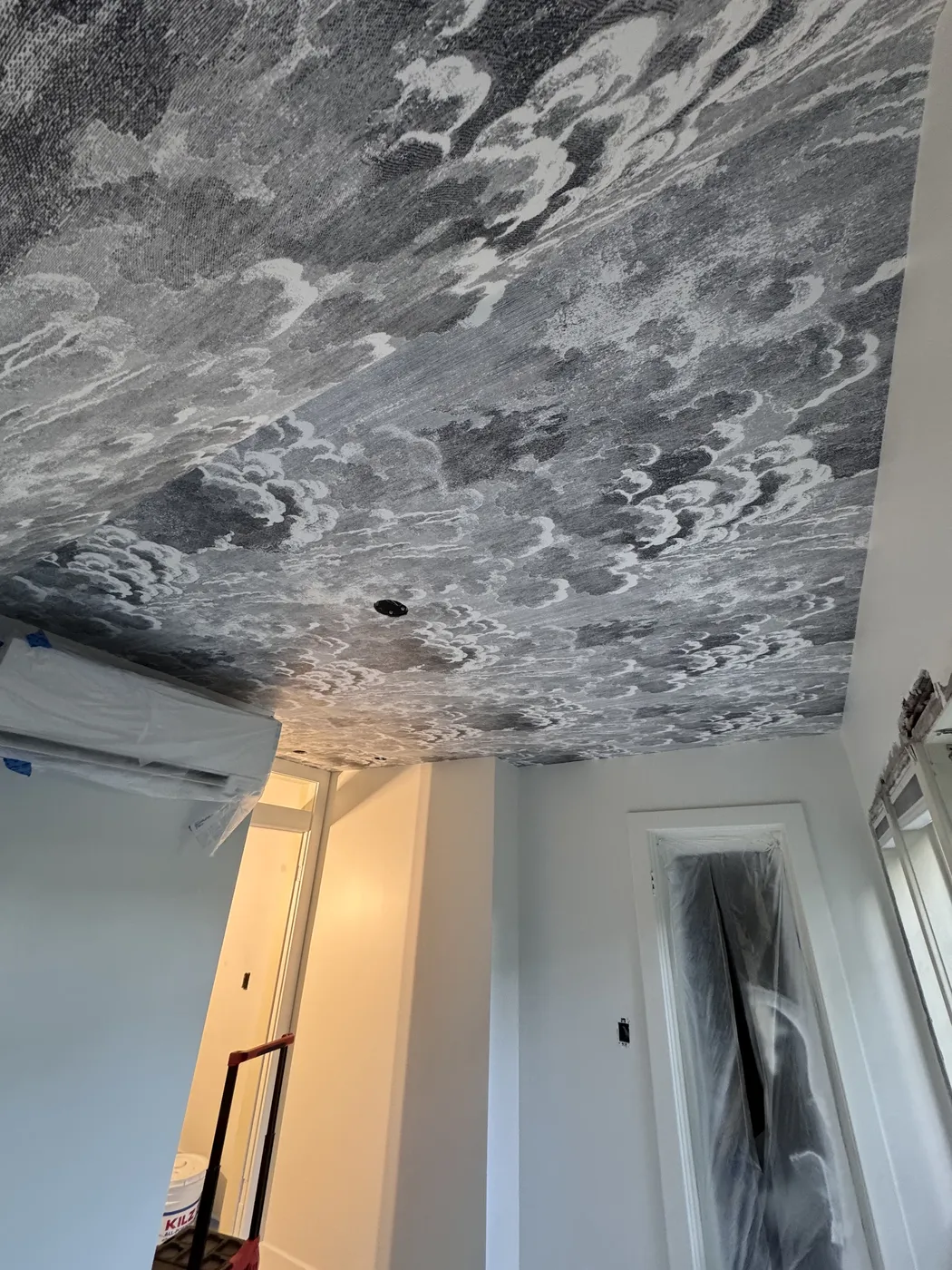
Ceiling wallpaper turns the most overlooked surface in a room into a design feature, often called the fifth wall. It can make a small room feel finished and intentional, draw the eye up in a room with good height, or add pattern without competing with art on the walls.
It is also a practical way to use a bold paper in a measured dose. Many people who would hesitate to cover four walls in a dramatic print are comfortable putting it overhead, where it reads like a canopy rather than a backdrop.
Which rooms work best for ceiling wallpaper?
The best candidates are rooms where you linger and look around: powder rooms, dining rooms, bedrooms, nurseries, entries and walk-in closets. Here are ideas that work well.
- Powder room. A small ceiling is a manageable first project, and patterned ceilings make a tiny room feel like a jewel box. See our powder room wallpaper ideas for pairings.
- Dining room. A pattern overhead frames the chandelier and adds drama for evening meals.
- Bedroom. You see the ceiling every night, so a soft botanical, a subtle texture or a starry print makes sense here.
- Nursery. Babies spend a lot of time looking up. Clouds, stars and gentle patterns are popular; our nursery and kids' room guide has more ideas.
- Entry or foyer. A patterned ceiling makes a strong first impression without taking wall space from mirrors and hooks.
- Closets, bay windows and alcoves. Small, defined ceilings are an easy way to add surprise.
- Commercial spaces. Boutiques, restaurants and lobbies use ceiling wallcoverings to create a memorable look, usually with durable commercial-grade materials.
What kind of wallpaper works best on a ceiling?
Lightweight papers with non-directional patterns work best. A ceiling is viewed from every direction, so a pattern with an obvious up and down will look upside down from somewhere in the room.
| Choice | On a ceiling | Notes |
|---|---|---|
| Non-woven, paste-the-wall | Excellent | Lightweight, dimensionally stable, easy to position overhead |
| Traditional pre-pasted or paste-the-paper | Good | Works well; booking and handling long wet strips overhead takes skill |
| Grasscloth and natural fibers | Possible | Heavy when pasted and visible seams; best on small ceilings with a strong adhesive |
| Metallic or foil | Use care | Amplifies every bump, especially under raking light from fixtures |
| Peel-and-stick | Not recommended | Gravity works against the adhesive, and edges tend to sag over time |
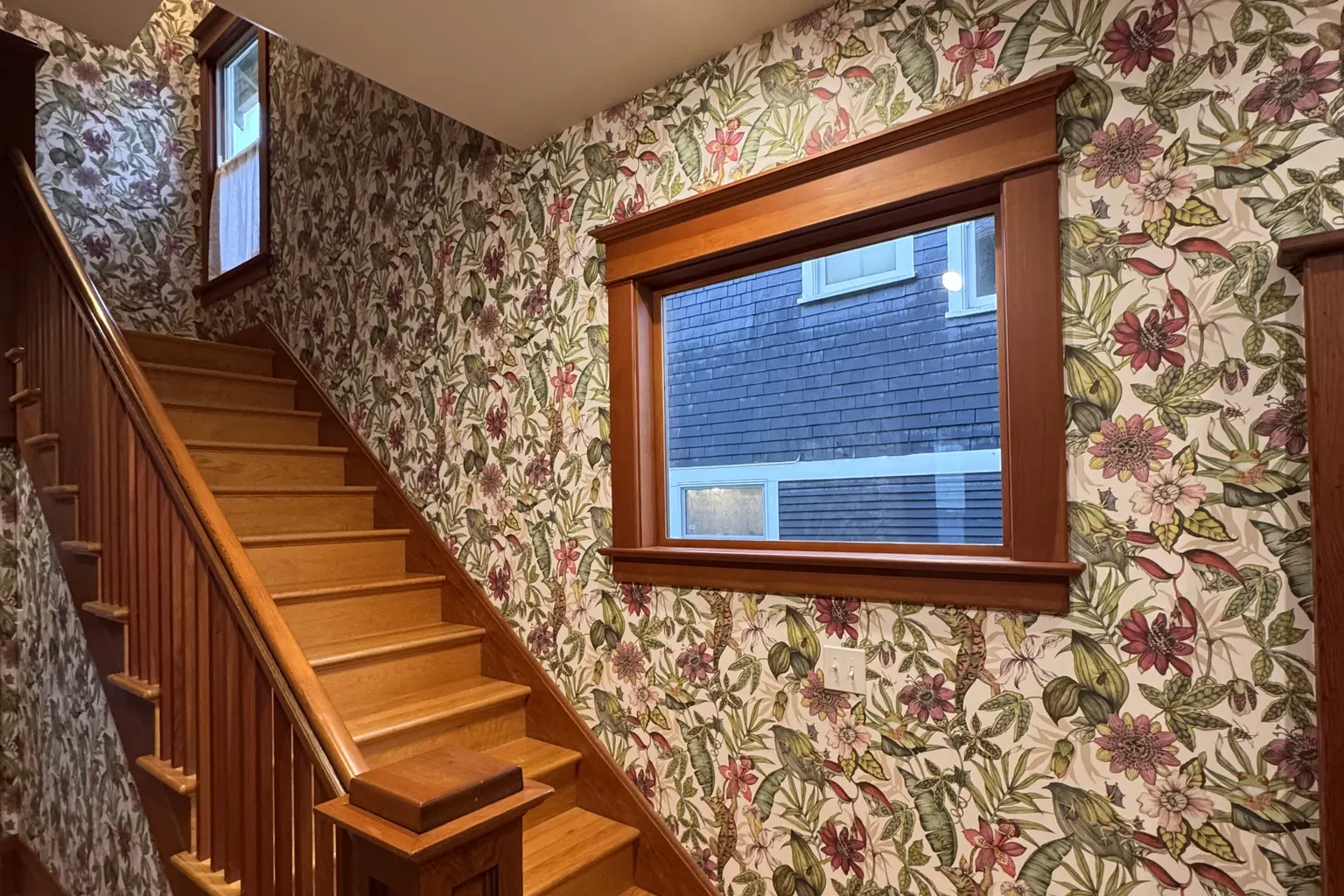
For pattern, look for all-over designs, geometrics, small florals that scatter in every direction, textures and tonal prints. Directional patterns such as trees, birds on branches or scenic toiles are usually better on walls. Our guide to metallic, silk and specialty wallpapers explains how the trickier materials behave.
Should the ceiling and walls match?
They can, but they do not have to. There are three common approaches, and each creates a different feel.
- Ceiling only, painted walls. The most popular choice. Pull a color from the paper for the walls so the room feels connected.
- Same paper on walls and ceiling. Creates a cocooning, enveloping effect that works well in small rooms. Expect the pattern to mismatch where the walls meet the ceiling; that is unavoidable.
- Coordinating papers. A bold pattern on the walls with a quieter texture or smaller print overhead, or the reverse.
If a crown molding is present, it gives a clean stopping point and hides small irregularities where the two surfaces meet. Without crown, the line at the top of the wall needs to be cut very straight, because the eye notices it.
How is ceiling wallpaper installed?
Ceiling wallpaper is hung much like wall paper, but working overhead makes every step slower and more physical. A good ceiling installation depends on preparation, layout and safe access.
Preparation
The ceiling should be smooth, clean and primed with a wallcovering primer. Ceilings often have more cracks, nail pops and taping lines than walls, and those need to be repaired and smoothed first. Our wall and ceiling preparation service handles this.
Popcorn and textured ceilings
Wallpaper cannot go over a popcorn ceiling. The texture must be removed and the surface skim coated. Older popcorn ceilings may contain asbestos, so the material must be tested before it is scraped, sanded or otherwise disturbed. If the home was built before 1978, painted surfaces may also contain lead and should be tested before sanding.
Layout and direction
Installers usually run strips across the shorter dimension of the ceiling, because shorter strips are easier to handle overhead. In some rooms, the strips run the other way so the pattern lines up with the main entrance or a focal wall. A chalk or laser line sets the first strip straight, since the walls themselves are rarely square to each other.
Fixtures and power
Light fixtures and fan canopies are loosened or removed so the paper can be trimmed neatly behind them. The power must be turned off at the breaker, not just the wall switch, before working around any fixture or electrical box with paste and water.
Access and a second set of hands
Ceiling work is typically done from a plank or scaffold rather than a single ladder, so the installer can walk the length of each strip. A long pasted strip is often supported with a temporary tool or a helper while it is positioned and smoothed.
What ceiling details should you plan around?
Recessed lights, smoke detectors, vents, beams and coved edges all affect layout, so walk the ceiling with your installer before choosing a pattern. Each detail means extra cutting, and a busy ceiling can make a large-scale print feel chopped up.
- Recessed lights. The paper is cut around each trim ring. Many recessed trims can be removed so the paper tucks neatly underneath.
- Smoke and carbon monoxide detectors. These are removed from their bases and reinstalled afterward. Make sure they go back up and are working before the job is done.
- Heating and ventilation registers. Grilles come off so the paper can be trimmed to the opening.
- Beams and trays. Papering only the recessed panels between beams, or the inset of a tray ceiling, is a striking way to use a bold paper with less material.
- Coved or curved edges. Curves make a crisp stopping line hard to achieve, so the paper is often carried down to a picture rail or a painted line.
Is ceiling wallpaper a good DIY project?
For most homeowners, ceiling wallpaper is one of the harder DIY projects. Holding a heavy wet strip overhead while aligning seams and trimming accurately is tiring and error-prone, and mistakes are very visible when you look up.
A small, flat powder room ceiling with a simple non-woven paper is the most realistic DIY candidate. High ceilings, stairwell ceilings, vaulted or sloped ceilings, and anything with a strong pattern match are where professional ceiling wallpaper installation is worth it.
Can ceiling wallpaper go in a bathroom?
Yes, with the right paper and good ventilation. Warm, moist air rises, so a bathroom ceiling sees more humidity than the walls do. That is especially true in the Pacific Northwest, where damp winters mean bathrooms can stay humid for long stretches.
Choose a paper rated for humid rooms, such as a vinyl or coated non-woven, and make sure the exhaust fan is vented to the outside and actually used. A powder room without a shower is a much easier ceiling than a full bath. Read more in our guide to wallpaper in Pacific Northwest bathrooms.
How much wallpaper do you need for a ceiling?
Measure the length and width of the ceiling to get the area, then let your installer calculate the number of strips from the roll width, the strip length and the pattern repeat. Square footage alone usually underestimates, because every strip is cut longer for trimming and pattern matching.
If you are papering walls and ceiling with the same pattern, order everything together from the same run. The roll count guide explains the math.
Schedule a free on-site estimate for your ceiling
Wallpaper Installer Seattle hangs ceiling wallpaper in homes and businesses across the area. We are licensed and insured with 10+ years of experience, and we come to you for a free on-site written estimate, checking the ceiling condition, fixtures and access in person. Call or text (425) 500-6842, email seattlewallpaper@gmail.com, or request your estimate online. We reply within 24 hours.
Related services
Frequently asked questions
Does ceiling wallpaper make a room look smaller?
Not necessarily. Light, airy patterns can make a ceiling feel higher, while dark or bold prints make a room feel cozier. In small rooms like powder rooms, a darker ceiling often makes the space feel intentional rather than cramped.
Can you wallpaper a vaulted or sloped ceiling?
Yes, but it takes more planning. Each plane is laid out separately, seams at the ridge and angles need careful trimming, and access requires scaffolding. Non-directional patterns help hide the transitions between angles.
Will ceiling wallpaper fall down?
Properly installed paper on a primed, sound ceiling stays put. Failures usually come from hanging over popcorn texture, flaking paint, poor primer, or using peel-and-stick overhead. Good prep is the key.
Should the ceiling be papered before or after the walls?
When both are being papered, the ceiling is usually done first. That way any small splashes of paste on the walls are covered by the wall paper, and the wall strips can be trimmed neatly against the ceiling line.
Can I wallpaper around a ceiling fan?
Yes. With the power off at the breaker, the fan canopy is loosened or the fan is lowered so the paper can be trimmed under the canopy. Heavy fixtures may need to be supported or removed temporarily.
Is ceiling wallpaper hard to remove later?
Strippable non-woven papers on a properly primed ceiling come down relatively easily. Traditional papers take more soaking and scraping, which is more tiring overhead. Using a good wallcovering primer makes future removal much simpler.