Quick answer
Bathroom wallpaper installation works well in Pacific Northwest homes when the material suits the room's moisture. Wallpaper Installer Seattle generally recommends solid vinyl or vinyl-coated paper for full baths with showers, non-woven for moderately humid rooms, and grasscloth only in powder rooms, always over a mildew-resistant wallcovering primer and with an exhaust fan that runs during and after showers.
Key facts
- Solid vinyl or vinyl-coated paper is the safest choice for full bathrooms with daily showers.
- Natural grasscloth absorbs water and stains easily; keep it in powder rooms.
- A mildew-resistant wallcovering primer seals the wall and makes future removal easier.
- Never hang wallpaper over active mildew; clean, dry and fix the moisture source first.
- Run the exhaust fan during showers and for at least 20 minutes after.
- Let the paste cure for a few days before the room gets steamy.
Can you put wallpaper in a bathroom in the Pacific Northwest?
Yes, you can wallpaper a bathroom here, and it holds up for years when the material, primer, adhesive and ventilation all match how the room is used. The Pacific Northwest is not a tropical climate, but it is damp for much of the year, and bathrooms add hot-shower steam on top of that. That combination is what makes bathroom wallpaper installation different from papering a bedroom or dining room.
From roughly October through May, outdoor air in the Seattle area stays cool and moist. Windows rarely get opened, so moisture from showers has fewer places to go. Exterior walls and window frames run cold, and cold surfaces are where steam condenses. Summers are usually dry, which is why a bathroom that seemed fine in August can show lifting seams by February.
The good news: most bathroom wallpaper failures trace back to one of four things, and all four can be controlled before the first strip goes up.
- The wrong paper for the room. A delicate uncoated paper right next to a shower.
- Unprepared or unsealed walls. Bare drywall, glossy paint, or a wall with existing mildew.
- Seams that let water in. Open or overworked seams in a splash zone.
- Not enough ventilation. A weak, blocked or unused exhaust fan.
What is the difference between a full bath and a powder room for wallpaper?
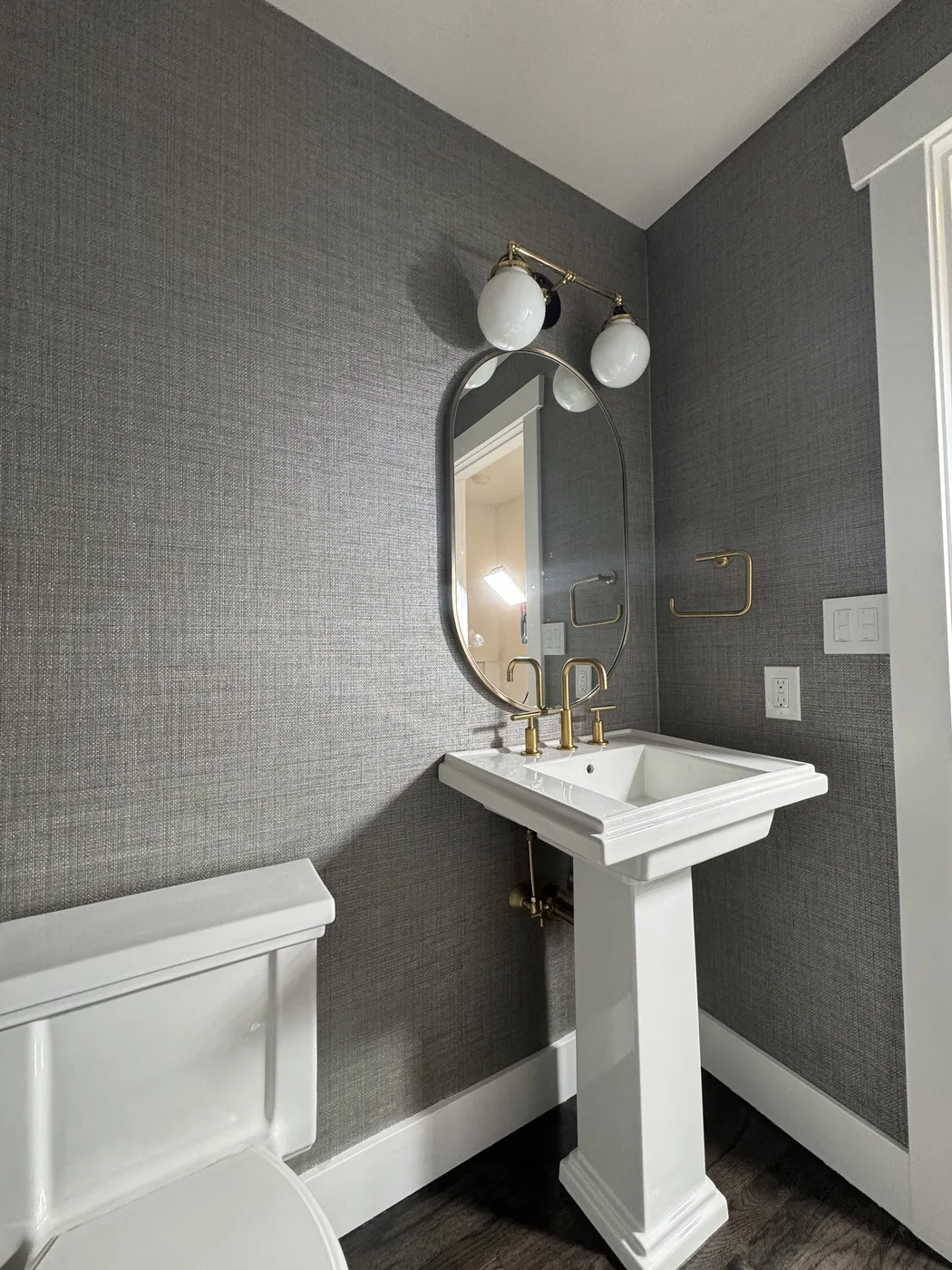
A full bathroom has a shower or tub that produces steam every day, while a powder room only sees hand-washing, so the two call for different materials. Think of bathrooms on a scale. A powder room is close to a normal living space and can take almost any wallcovering, including grasscloth and specialty papers (see our powder room wallpaper ideas). A guest bath with an occasional shower sits in the middle. A primary bath where two people shower daily is the most demanding room in most houses.
Within a full bath, the walls are not equal either. The wall shared with the shower, the area above the tub and the wall behind the sink take the most moisture. Walls on the far side of the room, especially interior walls, take far less. Many homeowners paper the dry walls and keep tile or paint in the wettest zone, which is a sensible compromise.
Which wallpaper is best for a bathroom: vinyl, non-woven or grasscloth?
For a full bathroom with a shower, solid vinyl or a vinyl-coated paper is usually the safest choice; non-woven works in moderately humid baths with good airflow; and natural grasscloth belongs in powder rooms, not steamy bathrooms. Here is how the common types compare.
| Wallcovering type | Moisture tolerance | Cleanability | Best bathroom use |
|---|---|---|---|
| Solid vinyl | High; the face sheds water | Washable to scrubbable | Full baths, kids' baths, high-use rooms |
| Vinyl-coated paper | Moderate | Usually washable | Guest baths with a good fan |
| Non-woven | Moderate; breathable and dimensionally stable | Varies; check the label | Ventilated baths, away from direct splash |
| Uncoated traditional paper | Low | Spot clean only | Powder rooms |
| Natural grasscloth | Low; water spots and stains | Dust only | Powder rooms, away from the sink |
Solid vinyl
Solid vinyl has a continuous vinyl face that water beads on, which makes it the workhorse for full baths. The tradeoff is that vinyl does not breathe. If moisture gets behind it through a seam or from a damp wall, it can be trapped there, which is why primer choice and tight seams matter so much with vinyl.
Non-woven
Non-woven wallpaper is made from a blend of natural and synthetic fibers that does not expand when wet, so seams stay tight and many products can be hung by pasting the wall. Most non-wovens breathe, which helps a wall dry out between showers. Some carry washable or scrubbable ratings and some do not, so read the roll label before choosing one for a bath.
Grasscloth and natural fibers
Grasscloth is beautiful, but it is a poor match for a room with a shower. Natural fibers absorb water, show splash marks and cannot be scrubbed. If you want texture in a full bath, consider a vinyl with a woven look, or keep the real thing in the powder room. Our grasscloth pros, cons and care guide goes deeper.
What about peel-and-stick?
Peel-and-stick can work on a dry wall in a lightly used bath, but steam and heat can soften some adhesives and make edges curl. In a daily-use shower bathroom, a traditional pasted product is more dependable. Our comparison of peel-and-stick vs traditional wallpaper covers the details.
Why does primer matter so much in a bathroom?
Primer is what lets bathroom wallpaper grip firmly, resist moisture at the wall surface and still come off cleanly years later. In a bathroom we use a primer made specifically for wallcoverings, and in a damp room we choose one formulated to resist mildew.
A good bathroom primer does three jobs:
- Seals the wall. Bare drywall and patched areas absorb paste unevenly. Sealing them gives the adhesive an even surface so it does not soak in and leave weak spots.
- Gives the paste something to grab. Semi-gloss bathroom paint is common in older homes. Paste does not bond well to it, so the surface is cleaned, dulled and primed.
- Resists mildew and protects the drywall. A mildew-resistant primer helps discourage growth under the paper and protects the drywall face, so future removal does not tear it up.
The adhesive matters too. Heavier vinyls typically call for a clear or clay-based paste rated for the product, and many professional pastes include a mildew inhibitor. We always follow the manufacturer's recommendation printed on the roll or spec sheet. Our wallcovering primer guide explains the main primer types.
One rule we never break: wallpaper does not go over active mildew. Spots are cleaned and treated, the wall dries fully, and the moisture source is addressed first. Papering over mildew only hides it for a season.
How important is bathroom ventilation for wallpaper?
Ventilation is the single biggest factor in how long bathroom wallpaper lasts, often more important than the paper itself. A working exhaust fan pulls warm, wet air out before it condenses on walls and seams.
Before we install, we look at the fan and ask how the room is used. A few checks you can do yourself:
- Hold a single square of tissue up to the fan grille while it runs. If the fan cannot hold it, it is moving very little air or the duct may be blocked.
- Notice how long the mirror stays fogged after a shower. A mirror that stays fogged means moisture is lingering on every wall.
- Look for peeling paint, dark spots in ceiling corners or swollen trim. Those signal a moisture problem that already exists.
Habits matter as much as hardware. Run the fan during the shower and for at least 20 minutes after, or put it on a timer or humidity-sensing switch. Leave the door open after showering so air can move. If the fan needs replacing or its duct needs work, have that done by a qualified electrician or contractor before the wallpaper goes up.
How do you prepare a bathroom wall for wallpaper?
Bathroom wall prep means removing fixtures and covers, repairing and smoothing the surface, cleaning off soap film and mildew, and priming with a wallcovering primer. Bathrooms usually need more prep than other rooms because they are small, full of fixtures and often repainted several times. Our wall preparation service covers this work.
- Power off at the breaker. Bathroom outlets and switches sit close to water, so we turn off power at the breaker before removing cover plates and working around them.
- Remove what comes off easily. Cover plates, towel bars, toilet paper holders and, where practical, mirrors. Fixed mirrors or recessed cabinets are discussed during the estimate.
- Remove old wallpaper. Hanging new paper over old bathroom wallpaper is risky because moisture may already have weakened the old layer. Our wallpaper removal service takes it down without gouging the drywall.
- Repair and smooth. Fill dents, skim rough areas and sand smooth. In homes built before 1978, old paint may contain lead, so it is tested before any sanding.
- Clean and degloss. Bathroom walls collect hairspray, soap film and skin oils. These come off, or paste will not bond.
- Prime. A wallcovering primer, mildew-resistant in a damp bath, applied evenly and allowed to dry per the label.
How are seams and edges handled in a bathroom?
In a bathroom, seams are kept tight, rolled lightly and wiped clean of paste, and edges near tubs, sinks and backsplashes are finished so water cannot wick behind them. A seam is the weakest point in any wallcovering, and in a humid room it is where lifting starts.
- We plan the layout so seams fall away from the sink and the shower opening where the pattern allows.
- Excess paste is washed off the face, because dried paste on vinyl collects grime and leaves shiny patches.
- Where paper meets a tub deck, vanity top or tile, it is trimmed cleanly and, where appropriate, sealed with a clear caulk compatible with wallcoverings so splashes cannot get under the edge.
- Strips that wrap outside corners near the shower are planned carefully, because those corners take abuse from towels and elbows.
How long does bathroom wallpaper last, and how should you care for it?
A well-chosen, properly installed bathroom wallpaper typically lasts many years, and the most important care step is letting the paste cure before the room gets steamy. We generally suggest skipping showers in that room for a few days after installation, or as long as the adhesive maker recommends.
After that, care is simple. Wipe splashes promptly with a soft, damp cloth. Use only the cleaning method the label allows, since "washable" and "scrubbable" are different ratings. Keep an eye on seams near the shower; if an edge starts to lift, call early, because a small re-adhesion is easy and a large failure is not.
If you are remodeling, the best time to wallpaper is after tile, plumbing fixtures, paint and fan work are finished, and before towel bars and accessories go up. That lets the paper finish neatly against everything else. Our wallpaper installation page explains the general process.
Get a free on-site estimate for your bathroom
Wallpaper Installer Seattle comes to your home anywhere in our service area, from Seattle and the Eastside to Everett and Tacoma, to look at your bathroom, check the walls and ventilation, and help you pick a material that fits the room. You get a free written estimate, and we confirm the roll count from our measurements before you order. Call or text (425) 500-6842, email seattlewallpaper@gmail.com, or request your free estimate online. We reply within 24 hours.
Related services
Frequently asked questions
Is it a bad idea to wallpaper a bathroom with a shower?
Not if you choose the right product and the room is ventilated. Solid vinyl or vinyl-coated wallpaper over a mildew-resistant primer, with tight seams and a working exhaust fan, can last for years in a full bath. Many people also keep tile or paint on the wall closest to the shower.
Can I put grasscloth in my bathroom?
Natural grasscloth is not recommended for bathrooms with a shower or tub because the fibers absorb moisture and show water spots. It can work in a powder room if it is kept away from the sink backsplash. Vinyl products with a woven look are a practical alternative for full baths.
Will wallpaper peel in a humid Seattle bathroom?
Peeling usually comes from poor prep, the wrong adhesive, open seams or a weak exhaust fan rather than the climate alone. Proper priming, a paste rated for the material and good ventilation address the main causes. If a seam lifts, re-adhering it early prevents a bigger repair.
Do I need to replace my bathroom fan before wallpapering?
Only if it is not moving enough air or is not vented properly. A quick tissue test and noticing how long the mirror stays fogged give a good first read. If the fan needs work, have a qualified electrician or contractor handle it before the wallpaper goes in.
How soon can I shower after bathroom wallpaper is installed?
We generally suggest waiting a few days so the adhesive can cure, or following the timing on the paste manufacturer's label. When you resume, run the exhaust fan during and after the shower. Avoid wiping the new paper until the paste has fully set.
Can wallpaper go behind a toilet or vanity?
Yes. We work carefully around toilets, pedestal sinks and vanities, trimming the paper to fit cleanly. Where paper meets a vanity top or backsplash, the edge is finished so splashes cannot wick behind it.