Quick answer
Powder room wallpaper can be bolder than anywhere else in the house because the room is small and has no shower. Large florals, chinoiserie, dark grounds, grasscloth and papered ceilings all work well. Wallpaper Installer Seattle recommends planning pattern placement around the vanity, protecting the sink area and confirming the roll count from on-site measurements before ordering.
Key facts
- No shower means powder rooms can use grasscloth, metallics and other specialty papers.
- Large-scale patterns often make a small room feel bigger, not smaller.
- The pattern mismatch where the last strip meets the first should land in the least visible spot.
- Protect the wall behind the sink with a backsplash or a wipeable paper.
- Most powder rooms need only a few rolls, but large repeats and ceilings add more.
- Many powder rooms are papered in a single day.
Why is a powder room the best place to try bold wallpaper?
A powder room is small, has no shower and is used in short visits, so it lets you go bolder with pattern, color and specialty materials than almost anywhere else in the house. Guests spend a minute or two there, which is exactly long enough to enjoy a dramatic print without it ever feeling overwhelming.
There is also a practical side. A typical powder room takes far fewer rolls than a bedroom or living room, so a premium paper that would be a big commitment across a great room becomes realistic here. And because there is no daily steam, you are not limited to vinyl the way you are in a full bath (our guide to wallpaper in Pacific Northwest bathrooms covers those steamier rooms).
That said, a powder room is one of the hardest rooms to hang well. It is tight, full of fixtures and corners, and every seam sits at eye level a few feet from a mirror. Planning matters more here than the square footage would suggest.
What powder room wallpaper ideas work best?
The powder room wallpaper styles that work best are the ones with a clear point of view: large-scale florals, chinoiserie, botanicals and jungle prints, dark moody grounds, graphic geometrics and natural textures. Here are directions that consistently look great in small rooms.
Large-scale florals and botanicals
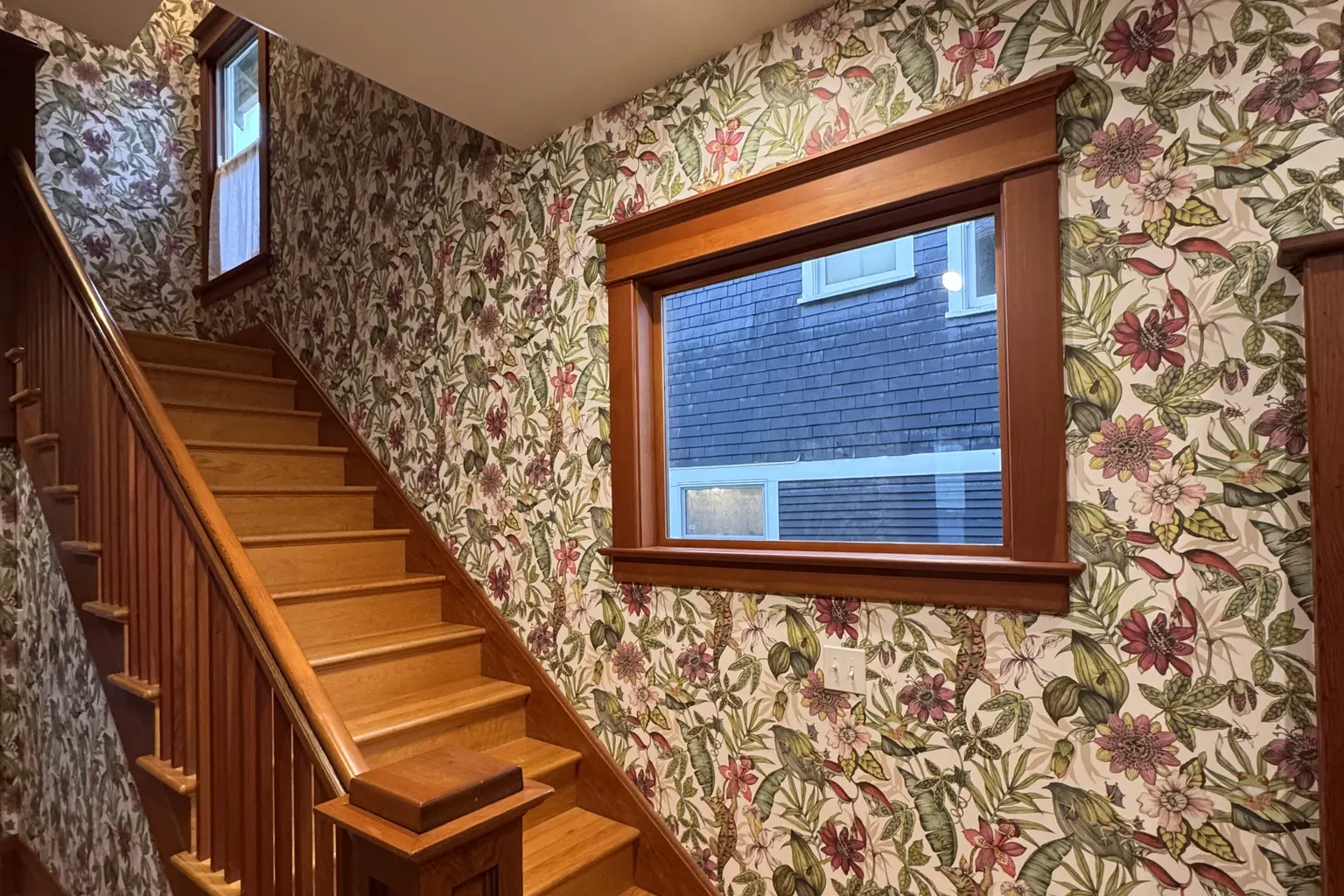
It sounds backward, but big patterns often make a small room feel larger. A large floral or leafy botanical reads as one continuous scene instead of busy repetition. Mid-century homes and newer builds alike can carry a big botanical, and in the Pacific Northwest, greens and woodland themes connect nicely to the views outside.
Chinoiserie and scenic murals
Hand-painted-style chinoiserie panels, birds and branches, or a scenic landscape turn a powder room into a jewel box. Many of these come as panel sets designed to run around a room in sequence, which means the layout must be planned panel by panel. Our wall mural installation service handles panel sets and scenic designs.
Dark and moody grounds
Black, deep navy, forest green or oxblood backgrounds with a lighter pattern create a cocooning effect, especially with warm brass fixtures. Dark papers are unforgiving of open seams, since a hairline gap shows the light wall underneath, so wall color under the paper and seam technique both matter.
Graphic and modern patterns
Geometrics, stripes, terrazzo looks and abstract prints suit modern and contemporary homes. These need precise layout because any drift off plumb, or a pattern that does not line up at a corner, is obvious in a geometric design.
Grasscloth, metallics and specialty papers
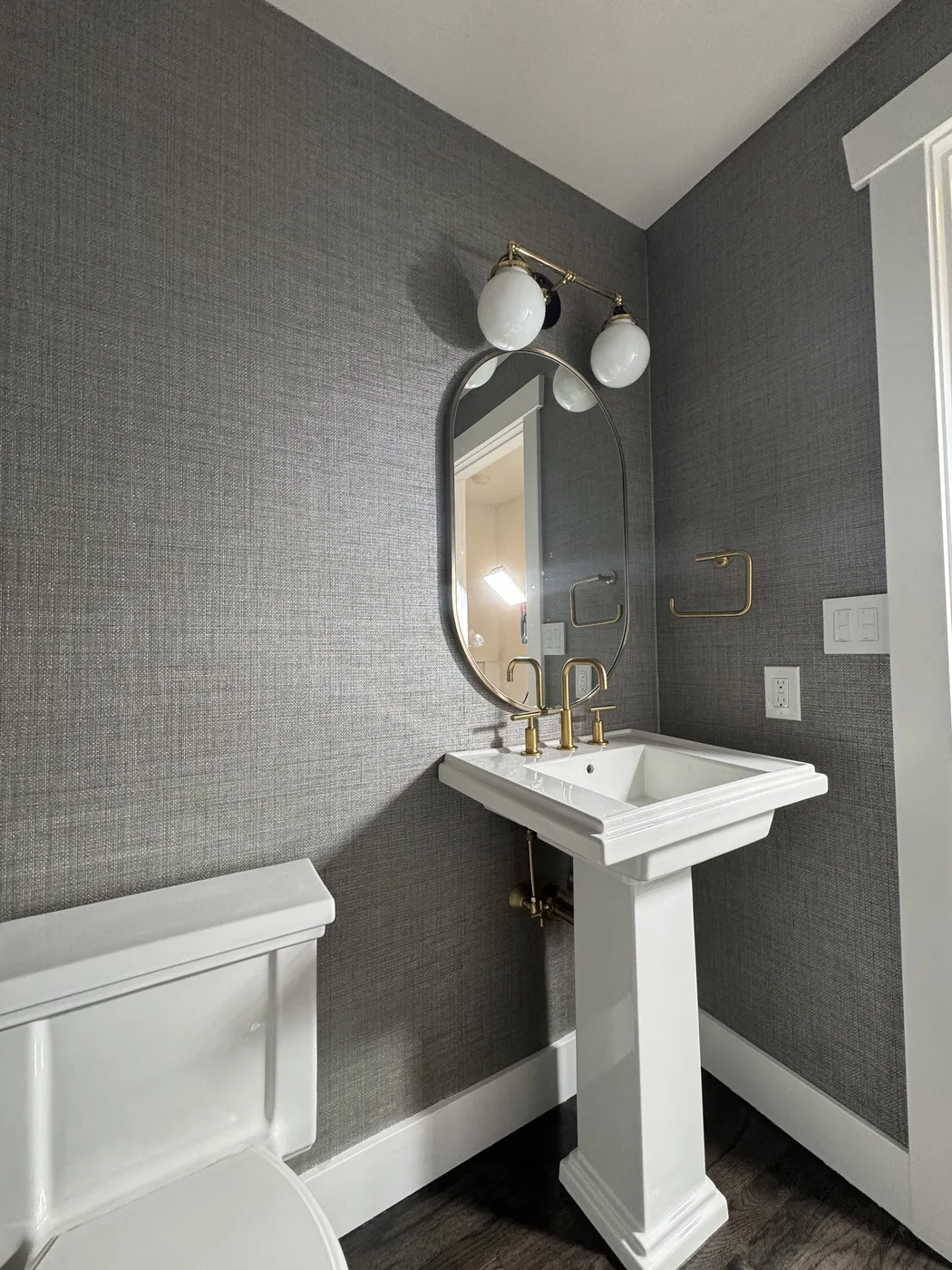
Grasscloth, cork, mica, foils and silks add texture and glow. A powder room is the ideal place for them because they dislike moisture and heavy wear. Keep in mind that natural grasscloth has visible seams and color variation between strips by nature; see grasscloth pros and cons and our guide to metallic, silk and specialty wallpaper.
Paper the ceiling, too
Running the paper onto the ceiling, or choosing a complementary print for it, wraps the room completely. It is one of the most striking powder room treatments and works especially well in rooms with a low or sloped ceiling. Read more in ceiling wallpaper ideas and tips.
How do you choose a pattern scale for a small powder room?
Choose a pattern scale based on how far away you will see it: small rooms are viewed up close, so medium and large patterns usually look intentional, while very tiny prints can blur into texture. Bring home a large sample, tape it to the wall and look at it from the doorway and from the sink.
- Large repeats (roughly 25 inches and up) feel like art, but they waste more paper when matching and may only show one or two full motifs per wall.
- Medium repeats are the most versatile and work in nearly every powder room.
- Small, dense prints can feel lively, but in a room with many corners they create more visible pattern breaks.
Also check the match type. A straight match, half-drop or random match changes how much paper you need and where breaks land. Our guide to pattern repeat and match types explains each one.
How many rolls of wallpaper does a powder room need?
Most powder rooms need only a few rolls, but the exact count depends on wall height, the roll's width and length, the pattern repeat and how many doors and fixtures interrupt the walls. Because the room is small, a single short roll makes a big difference, and running out mid-job is a real risk if the count is guessed.
A few things push the count up in powder rooms: tall ceilings, large pattern repeats, papering above a wainscot that is shorter than expected (shorter strips save less paper than you might expect, because each one still has to align with the pattern repeat), and a papered ceiling. We measure on site and confirm the roll count with you before you order. Buy all rolls from the same batch or dye lot, since colors can vary between runs. Our roll count guide walks through the math.
What makes powder room installation harder than it looks?
Powder rooms are harder to hang than their size suggests because every strip has to be cut around something: a door casing, a pedestal sink, a toilet, a mirror, a window, outlets and switches, and usually several inside and outside corners. Here is what a careful installation involves.
- Plan where the pattern starts and ends. In a room that wraps all the way around, the last strip meets the first, and the pattern almost never matches there. We plan the starting point so that this unavoidable mismatch lands in the least visible spot, often above the door or in a corner behind the door.
- Center the focal wall. The wall behind the vanity is what everyone sees. We center a strong motif on the mirror or sink when the pattern allows.
- Turn off power at the breaker. Before removing cover plates around the sink, power is off at the breaker.
- Work around the toilet. We trim carefully behind and around the tank. If a tank or fixture needs to come off to get a clean result, that is discussed during the estimate and coordinated with a plumber when needed.
- Handle the mirror. A hung mirror usually comes down so the paper runs continuously behind it. Large glued-on mirrors are left in place and the paper is trimmed neatly to the edge.
- Plumb every wall. Older homes rarely have perfectly straight walls or level ceilings. Each wall gets its own plumb line so the pattern stays vertical even if the room is not.
What should you know about the sink area?
The sink is the only wet zone in a powder room, so the wall directly behind and beside it deserves a little extra thought. Splashes from hand-washing are small but frequent, and over time they can stain uncoated papers and grasscloth.
- A backsplash, even a short one, protects the paper most effectively.
- If you choose an uncoated or natural paper, keep the edge a little above the faucet height or plan on a backsplash.
- Where the paper meets the vanity top or backsplash, the edge is trimmed cleanly and can be sealed with a clear, compatible caulk.
- A working exhaust fan or an openable window helps, especially in a powder room off a busy entry or kitchen.
What wall prep does a powder room need?
Powder room walls need to be smooth, clean, sound and primed with a wallcovering primer before paper goes up, just like any other room. Because powder rooms are often in older parts of the house or were painted with glossy paint, they frequently need patching and deglossing.
Textured walls, common in many Seattle-area homes built in the later 20th century, show through thinner papers and should be skimmed smooth first. In homes built before 1978, painted surfaces are tested for lead before sanding. Under dark papers, we often tint or color the primer close to the background color so that any tiny seam gap is less visible.
Quick comparison: powder room materials
| Material | Look | Powder room notes |
|---|---|---|
| Traditional paper | Crisp prints, matte finish | Excellent choice; protect the sink area |
| Non-woven | Wide range of prints | Easy to hang and remove; stable seams |
| Vinyl or vinyl-coated | Durable, often wipeable | Good for busy households and kids |
| Grasscloth | Natural woven texture | Stunning; visible seams and shade variation are normal |
| Metallic, foil, mica | Reflective, glamorous | Needs a very smooth wall; shows every flaw |
| Mural panel set | Scenic, one-of-a-kind | Panel order and centering must be planned |
How long does a powder room installation take?
Many powder rooms are papered in a single day, though rooms with removal, heavy patching, a papered ceiling or a mural panel set can take longer. Prep and priming sometimes happen on a separate visit so the primer can dry properly. You can usually use the room again the same day once cleanup is done, but avoid wiping the paper for a day or two. For a full picture of the day, see what to expect on installation day.
Plan your powder room with a free on-site estimate
Wallpaper Installer Seattle comes to your home to measure the room, check the walls, talk through pattern placement and confirm how many rolls to order. The estimate is free and written, and we serve 23 cities from Everett to Tacoma, including Seattle, Bellevue and Kirkland. Call or text (425) 500-6842, email seattlewallpaper@gmail.com, or send a request for your free estimate. We reply within 24 hours.
Related services
Frequently asked questions
Should I wallpaper all four walls of a powder room or just one?
Most powder rooms look best fully papered, because the room is small enough that one accent wall can feel unfinished. An accent wall behind the vanity can work with a mural or a very bold print. Papering the ceiling as well creates the most dramatic effect.
Does dark wallpaper make a powder room feel smaller?
Dark wallpaper usually makes a powder room feel cozier and more dramatic rather than cramped, because the corners visually recede. Good lighting, such as sconces or a statement fixture, helps a dark room glow. Seams need to be very tight on dark grounds so the wall does not show through.
Can I use grasscloth in a powder room?
Yes, a powder room is one of the best places for grasscloth because there is no shower steam. Keep it away from direct sink splash or add a backsplash. Expect visible seams and natural color variation between strips, which is part of the material's character.
Do you remove the toilet to wallpaper a powder room?
Usually not; the paper is carefully trimmed around and behind the tank. If a fixture truly needs to come off for a clean result, we discuss it during the estimate and coordinate with a plumber when needed. Mirrors that hang on hooks are typically taken down so the paper runs behind them.
Can I put wallpaper on a powder room ceiling?
Yes, ceilings are a popular powder room choice and can use the same paper as the walls or a coordinating print. The ceiling must be smooth and sound, and older textured ceilings that may contain asbestos should be tested before they are disturbed. Ceiling work is often done first so the walls finish cleanly against it.